
Hope Is Cooked
已更新:1天前

At noon, the charity kitchen is hotter than anywhere else around Jiangxi Cancer Hospital.
The kitchen is outdoors, squeezed beneath a corrugated roof that traps the midsummer heat. Oil crackles in woks. Steam escapes from soup pots. Plastic fans stir warm air that never seems to cool anyone. Outside, the temperature reaches thirty-six degrees Celsius. Inside, standing over the stove feels even hotter. Yet by noon every cooking station is occupied.
Most of the people here are not patients. They are husbands, wives, children and even parents. They have all become cooks for their family.
The first man I met looked no older than his thirties. His wife had been diagnosed with nasopharyngeal cancer. Many families cook only once a day. They prepare lunch and reheat the leftovers for dinner, saving both time and money. "I come twice," he told me, “Once at noon. Once again in the evening. So she can eat fresh food." On the stove simmered a bitter melon soup beside a plate of stir-fried bean sprouts. Unlike regular Jiangxi dishes, there was almost no seasoning. "A little oil. A little salt." Nothing spicy. Nothing heavy. Only what she could still swallow.
He was not from Nanchang. Very few people using the kitchen were. Local families could usually return home to cook. The people gathered here had traveled from smaller cities and counties across Jiangxi, carrying suitcases instead of grocery bags, turning hospital wards into temporary homes.

Next to this loving husband, another pan hissed. A woman stood quietly frying vegetables. At first, I assumed she was cooking for her husband. Instead, she pointed toward the hospital, "My daughter." Her daughter was twenty-one.
She had recently begun working in Nanjing when she noticed something strange, "It always felt like something was stuck in her throat. She kept coughing,” Doctors removed what appeared to be a small growth. Then, a pathology report changed everything: she had NK/T cell lymphoma. The medical jargon might be a stranger to this mother, but she recounted it with perfect clarity, because it was synonymous with enemy. Chemotherapy followed. This was already her third cycle.
The mother stirred a large pot of soup filled with mushrooms, vermicelli, meatballs, and greens. Beside it sat chicken wings and another vegetable dish. "She wanted these today." That was enough reason to cook. At first, she admitted, she tried forcing her daughter to eat, "How can you recover if you don't eat?" But chemotherapy had its own logic. "She ate. Then she vomited. So now I don't force her anymore." Now, she is used to waiting. Whenever her daughter says she wants something—even if it is only one bite—she comes to the kitchen. "I'll cook whatever she wants," she conceded. Cancer had taken away certainty. It had not taken away a mother's instinct to feed her child.
The kitchen also eased the financial burden, since treatment was expensive. Every family knew that—it was almost an instinct to save money. "The fees here are reasonable," the mother explained. There was another small kitchen inside the hospital, but it lacked basic cooking supplies like cooking oil and seasonings. But here, everything was ready. Every yuan saved on meals became another yuan that could go toward treatment.
While she talked only about money, what frightened her most was uncertainty. There is no guarantee for complete recovery. Even after treatment, there is always the possibility of recurrence. The psychological pressure is even greater although no one brought it up.
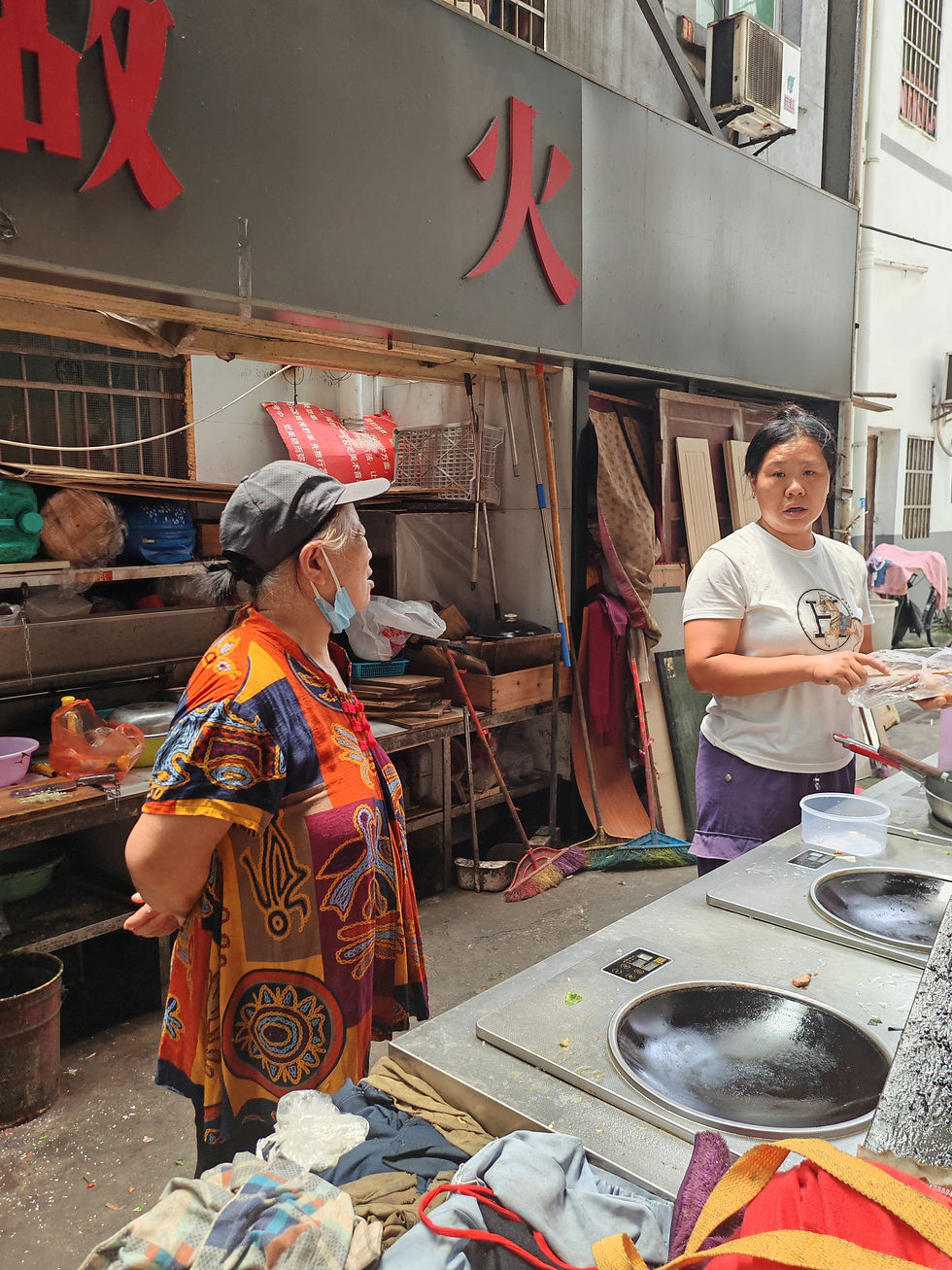
Near another stove, a woman carefully browned pieces of fish before adding water to let them simmer. It smelled unmistakably Jiangxi. She was cooking for her husband, who also had nasopharyngeal cancer. They had come from Yingtan, more than two hours away. "What else can I do?" she said with a tired smile, "If I don't come, who will take care of him?" She looked barely forty, and her husband was about the same age. Neither of them should have been spending their middle age in a cancer hospital. Yet here they were, discussing fish instead of fear.

One family had arrived only the day before. Treatment had not even begun. They were still cooking several dishes, taking advantage of the patient's appetite while it lasted. "Eat more now," someone encouraged them, "After chemotherapy, it becomes much harder." The advice passed naturally between strangers. Nobody asked whether it was welcome. Everyone already understood.
In a cancer hospital, there are few things families can control. They cannot control pathology reports, chances of recurrence or even the appetite of their loved ones. But every afternoon, inside a small kitchen behind the hospital, they can still choose what to cook for the people they love. And perhaps that ordinary choice—the simple act of preparing someone's favorite meal—is itself a quiet form of hope.


留言